A hurt wrist is not a reason to sit down for six weeks. It is a reason to train everything else.
Most players get this backwards. They ask “what can I still do with a bad wrist?” and end up on a bike for twenty minutes, bored. The better question is the one a professional’s physical coach asks:
Because when the wrist is ready, you want to walk back on court as the same athlete — not a slower, softer version of yourself who now has to spend two months getting fit again.
The Whole Session in One Picture
Screenshot this. Send it to a team-mate. Take it to the court.
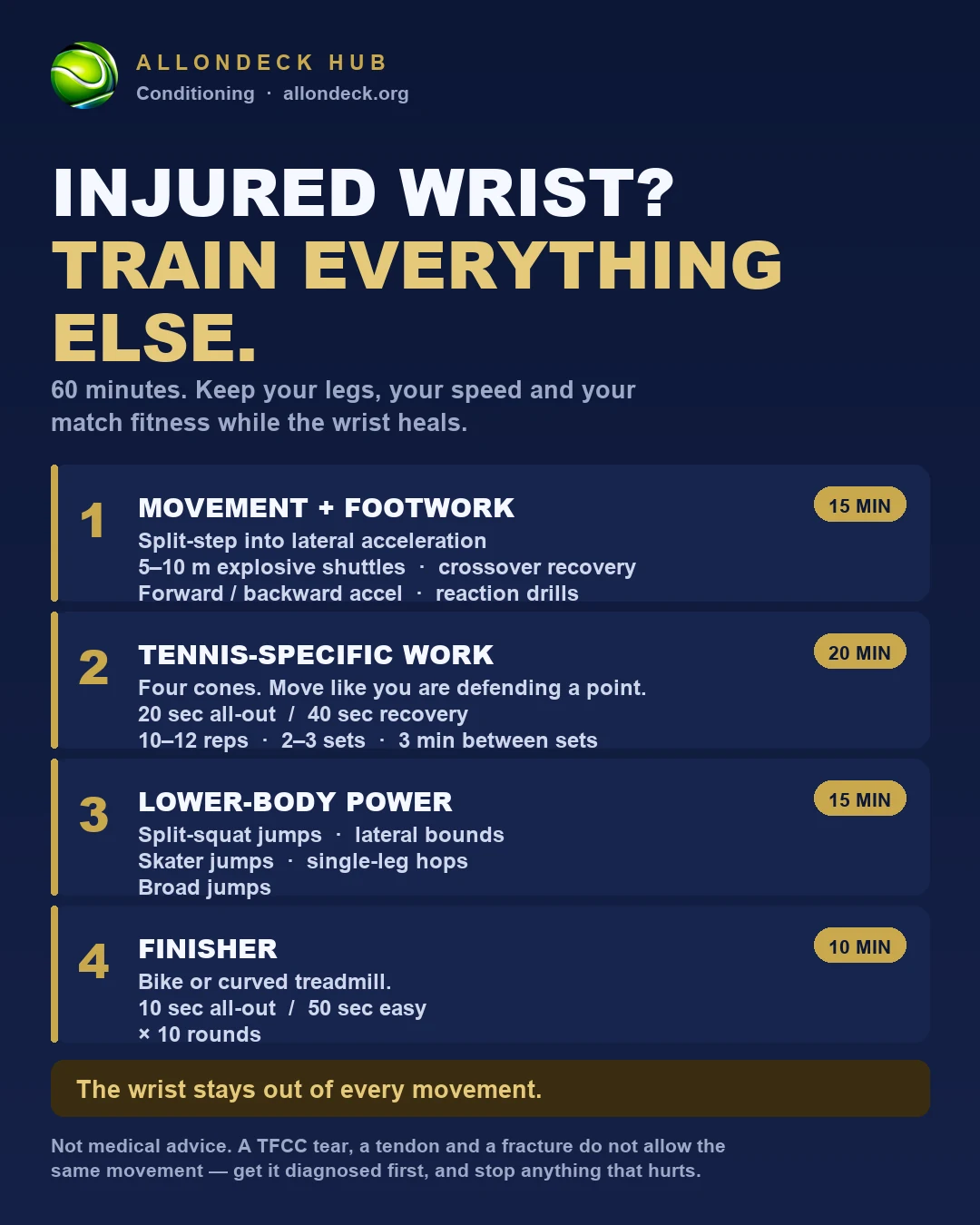
The Four Blocks
Movement + footwork
15 MIN- Split-step into lateral acceleration
- 5–10 m explosive shuttles
- Crossover recovery steps
- Forward and backward acceleration
- Random-direction reaction drills
Tennis-specific conditioning
20 MINFour cones: a baseline and two sidelines. Move like you are defending and recovering in a real point — explosive first step, change of direction, back to the middle.
Three minutes between sets. This block is the one that keeps your match fitness.
Lower-body power
15 MIN- Split-squat jumps
- Lateral bounds
- Skater jumps
- Single-leg hops
- Broad jumps
Conditioning finisher
10 MINBike or curved treadmill.
Read This Before You Start
This is a general conditioning session, not medical advice, and it is not a diagnosis. “Wrist injury” covers very different problems — a TFCC tear, a tendon, a stress fracture — and they do not all allow the same movement. A fracture in particular can rule out impact work that a tendon problem would not.
Get it looked at first
Get a proper diagnosis before you follow any plan, including this one. Once you know what the injury actually is, the exercise choices can be far more precise — and a physio can tell you which of the four blocks above to change. If anything here causes wrist pain, stop that movement. Pain is information, not weakness.
The Point of All This
An injury takes away one thing. Most players let it take away five: their speed, their legs, their conditioning, their sharpness, and their habit of training hard. Those four blocks exist so that the wrist is the only thing you have to rebuild.
Six weeks off, done well, is six weeks of leg strength you did not have before. Done badly, it is three months lost.
Train around the injury with a coach who knows the sport
AllONDECK coaches build sessions around what you can do, not what you cannot. Find one near you, or work remotely.