Almost everyone with tennis elbow does the same two things in the wrong order: they play through it until it is bad, then they rest it completely until it goes quiet. Then it comes back.
A tendon is not a bruise. It does not heal by being left alone — it adapts to load, and a tendon that gets none at all for six weeks comes back less able to cope than the one that got you injured. That is why the cycle repeats.
The session below keeps everything a sore elbow does not touch, which is almost all of you, and leaves the tendon work to someone who can set the dose.
The Whole Session in One Picture
Screenshot this. Send it to a team-mate. Take it to the court.
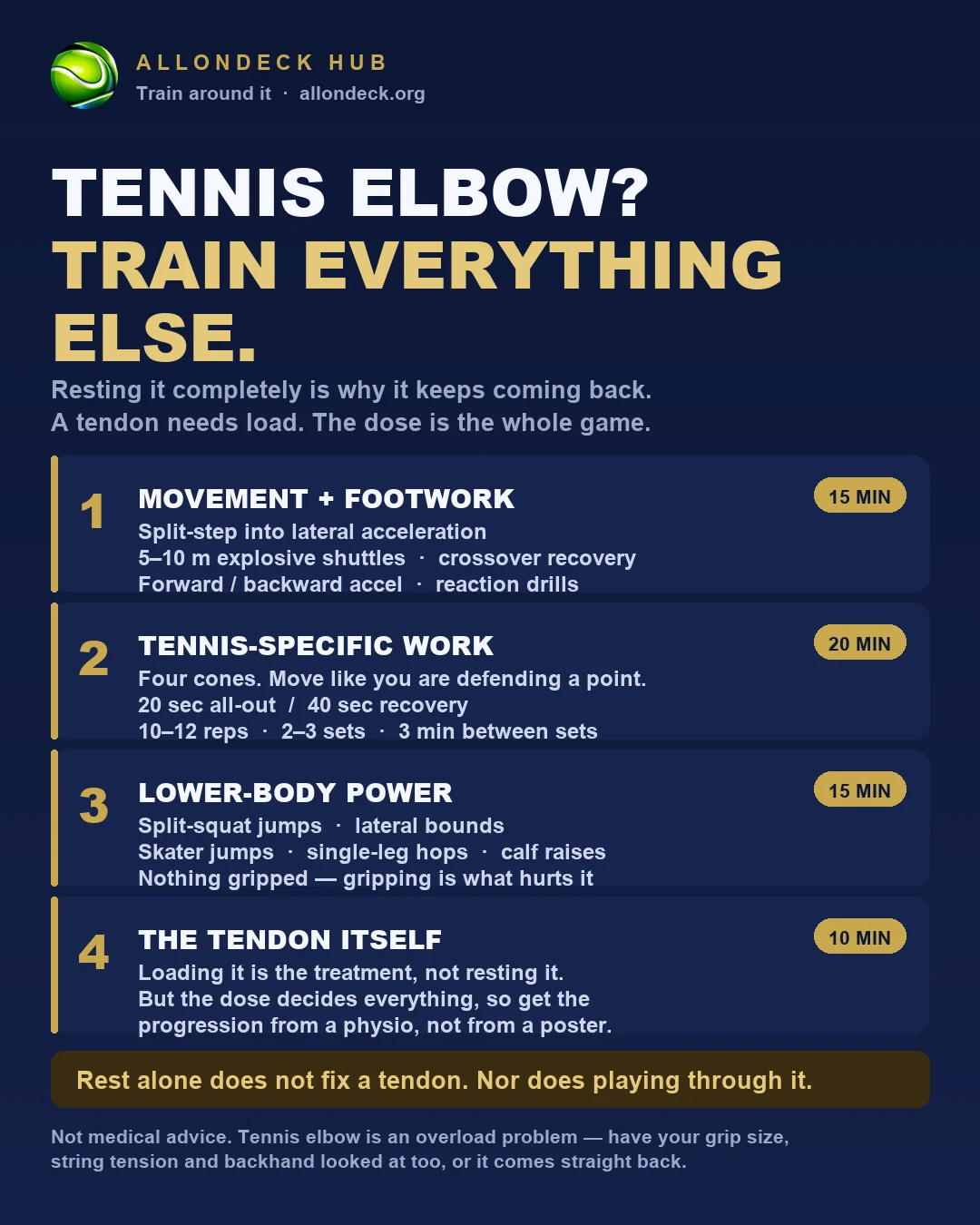
The Four Blocks
Movement + footwork
15 MIN- Split-step into lateral acceleration
- 5–10 m explosive shuttles
- Crossover recovery steps
- Forward and backward acceleration
- Random-direction reaction drills
Tennis-specific conditioning
20 MINFour cones: a baseline and two sidelines. Move like you are defending and recovering in a real point.
Three minutes between sets.
Lower-body power
15 MINGripping is the thing that hurts, so nothing is held. Same rule as the wrist session, and the exact opposite of the shoulder one.
- Split-squat jumps
- Lateral bounds
- Skater jumps
- Single-leg hops
- Calf raises
The tendon itself
10 MINThis block is different from every other card in the set, and it is worth understanding why.
- Loading the tendon is the treatment, not resting it
- But the dose decides whether it helps or flares it
- So the progression comes from a physio, not a poster
Why Complete Rest Backfires
Rest takes the pain away, because pain comes from load and you have removed the load. Nothing about the tendon has improved. So you return to the same volume, with the same grip, the same strings and the same backhand, on a tendon now less able to handle it than before you stopped. It hurts again within a fortnight, and the player concludes they did not rest long enough.
They rested exactly as long as the problem required. The rest was just never the treatment.
The Part Most Players Skip
Tennis elbow is an overload problem, which means something is overloading it. Get these looked at while you are managing the tendon, or you will fix it and then recreate it.
Grip size. A grip that is too small makes you squeeze harder for an entire match. String tension. Tighter strings put more through the arm, and a softer string at lower tension is one of the cheapest changes you can make. Your backhand. A late, wristy one-hander is the classic cause, and no amount of tendon work outlasts a technique that keeps reloading it.
A coach can see the third one in five minutes. It is worth the session.
Read This Before You Start
This is a general conditioning session, not medical advice, and it is not a diagnosis.
Get it looked at first
Pain on the outside of the elbow is usually the common extensor tendon, but not always. Nerve irritation and joint problems can feel similar and are managed differently. If you have pins and needles into the hand, night pain, or the elbow locks or will not straighten, that needs assessing rather than loading.
The Point of All This
You are not injured from the shoulder down. You are injured in one tendon. The legs, the engine and the movement that took years to build are all still available, and they are exactly what quietly disappears during a six-week break.
Fix the tendon properly, with load, on somebody’s timetable. Keep everything else sharp while you do.
Train around the injury with a coach who knows the sport
AllONDECK coaches build sessions around what you can do, not what you cannot. Find one near you, or work remotely.