You cannot serve. That is one shot. It is not your whole game, and it is certainly not your fitness.
A shoulder is the injury players take hardest, because serving is the thing that feels most like tennis. But look at what a shoulder actually stops: overhead, pressing, and loading through the arm. It stops none of your movement, none of your legs, and none of your conditioning.
The Whole Session in One Picture
Screenshot this. Send it to a team-mate. Take it to the court.
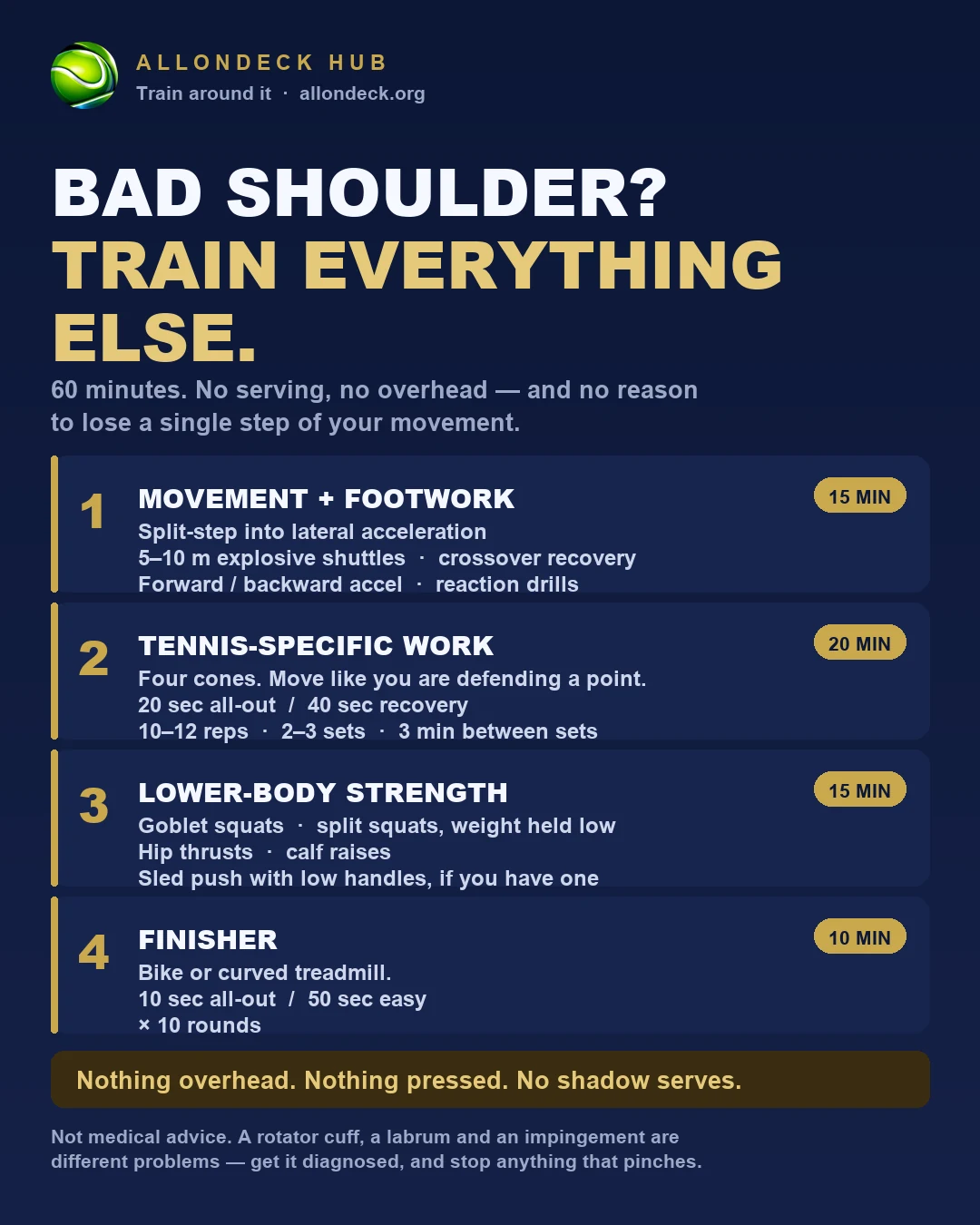
The Four Blocks
Movement + footwork
15 MIN- Split-step into lateral acceleration
- 5–10 m explosive shuttles
- Crossover recovery steps
- Forward and backward acceleration
- Random-direction reaction drills
Tennis-specific conditioning
20 MINFour cones: a baseline and two sidelines. Move like you are defending and recovering in a real point.
Three minutes between sets. This is the block that keeps your match fitness.
Lower-body strength
15 MINHere is where this differs from a wrist injury: your hand works. You can hold weight, as long as it stays low and nothing is pressed.
- Goblet squats
- Split squats, weight held at your side
- Hip thrusts
- Calf raises
- Sled push with low handles, if you have one
Conditioning finisher
10 MINBike or curved treadmill.
What Is Different From a Wrist Injury
If you have read the wrist version of this session, block 3 is the part that changed, and it changed for a reason. A wrist injury means you cannot grip a loaded dumbbell, so the lower-body work has to be jumps — bodyweight, explosive, nothing held.
A shoulder injury is the opposite. Your hand and forearm are fine, so you can hold real weight, as long as it never goes overhead and is never pressed. That means you can get genuine strength work in, not just plyometrics. Use it. Six weeks of proper lower-body strength is not a consolation prize.
Read This Before You Start
This is a general conditioning session, not medical advice, and it is not a diagnosis.
Get it looked at first
A rotator cuff tear, a labral tear and an impingement are different problems with different rules, and a shoulder that hurts at the top of the serve is not automatically any of them. Get a proper diagnosis before you follow any plan, including this one. If something pinches at a particular point in the range, stop there — that is the signal, not a challenge.
The Point of All This
A shoulder takes your serve away for a while. It does not have to take your first step, your legs, your conditioning or your habit of training hard. Those are the things that take months to rebuild and days to lose.
When the shoulder is ready, the only thing you should have to rebuild is the serve.
Train around the injury with a coach who knows the sport
AllONDECK coaches build sessions around what you can do, not what you cannot. Find one near you, or work remotely.