A knee takes away jumping, landing and hard stops. It does not take away getting strong — as long as you change which joint does the work.
The trick is one word: hinge. Bending the knee under load is what hurts. Hinging at the hip generally is not, and it happens to load the glutes and hamstrings hard — the exact muscles that protect a knee when you come back.
So this session does not tiptoe. It moves the work up one joint.
The Whole Session in One Picture
Screenshot this. Send it to a team-mate. Take it to the court.
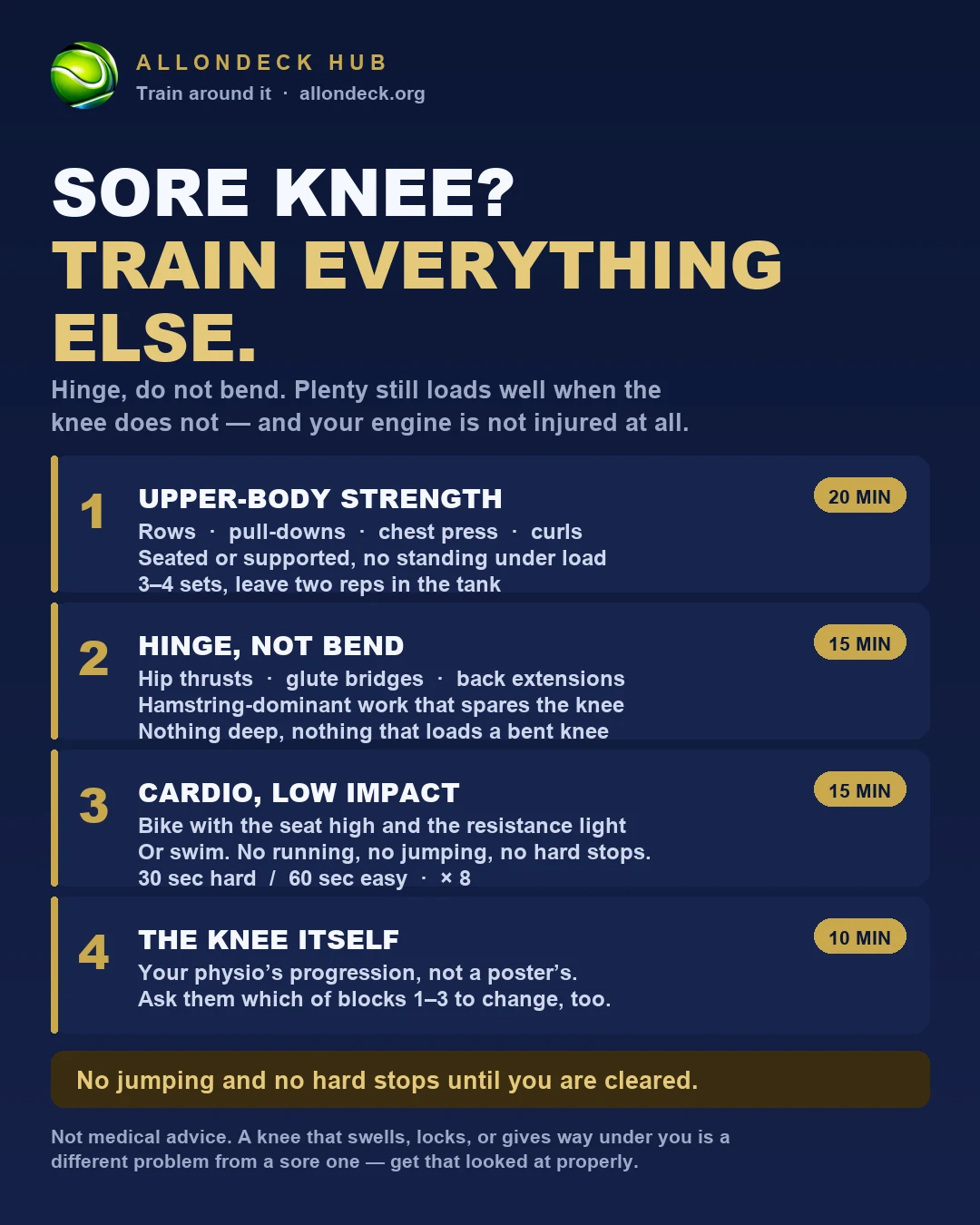
The Four Blocks
Upper-body strength
20 MINSeated or supported, so you are not standing under load on it.
- Rows
- Pull-downs
- Chest press
- Curls and triceps
- 3–4 sets, leaving about two reps in the tank
Hinge, not bend
15 MINHip-dominant work. The knee stays quiet while the glutes and hamstrings do the job.
- Hip thrusts
- Glute bridges
- Back extensions
- Standing hamstring curls, if pain-free
Cardio, low impact
15 MINBike with the seat high and the resistance light, or swim.
The knee itself
10 MINYour physio’s progression, not a poster’s.
- Ask them which of blocks 1–3 to change, too
Why Hip Work Is Not a Compromise
Weak glutes are one of the reasons knees get sore in the first place. When the hip does not control the leg, the knee ends up absorbing the deceleration — every change of direction, every skid, every stop. So the block you can do is also, very often, the block you needed.
Players who use a knee layoff to build a hip they never trained often come back moving better than they left. That is not a consolation story. It is what happens when you finally train the thing you were skipping.
Read This Before You Start
This is a general conditioning session, not medical advice, and it is not a diagnosis.
These need looking at, not managing
A knee that swells, locks, catches, or gives way under you is a different problem from a sore one. Those point at the meniscus or a ligament, and no amount of sensible conditioning sorts them out. The same goes if it followed a twist you felt go. Get it assessed.
The Point of All This
Knees keep players out for weeks and take their legs with them, because the instinct is to stop training legs altogether. You do not have to. Move up one joint and you keep most of your strength, all of your engine, and the glute work that makes the knee safer when you return.
Train around the injury with a coach who knows the sport
AllONDECK coaches build sessions around what you can do, not what you cannot. Find one near you, or work remotely.