Every other session on this site tells you to keep your legs. This is the one where the legs are the injury.
So the session changes shape completely. The work goes upstairs, the conditioning comes off the floor, and the ankle itself is handled by somebody who has actually looked at it.
This is the least glamorous card in the set and probably the most useful, because an ankle is the injury players most often rush.
The Whole Session in One Picture
Screenshot this. Send it to a team-mate. Take it to the court.
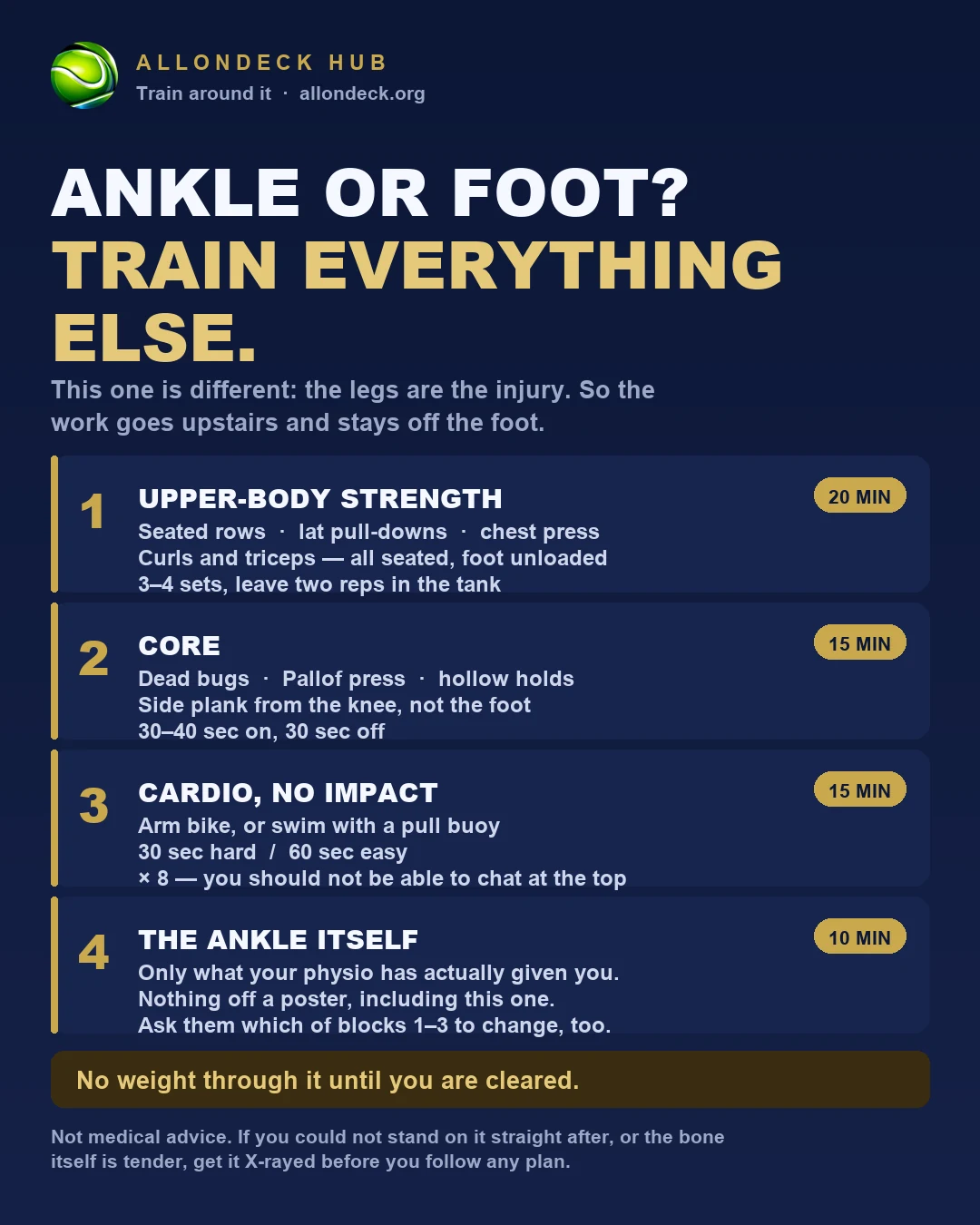
The Four Blocks
Upper-body strength
20 MINAll seated, foot unloaded. This is the block that finally gets done properly, because for once you have the time.
- Seated rows
- Lat pull-downs
- Chest press
- Curls and triceps
- 3–4 sets, leaving about two reps in the tank
Core
15 MIN- Dead bugs
- Pallof press
- Hollow holds
- Side plank from the knee, not the foot
30–40 seconds on, 30 seconds off.
Cardio, no impact
15 MINArm bike, or swim with a pull buoy between your legs so the foot does nothing.
If you can hold a conversation at the top of the hard interval, it is not hard enough.
The ankle itself
10 MINOnly what your physio has actually given you.
- Nothing off a poster, including this one
- Ask them which of blocks 1–3 to change, too
Why Block 4 Is Almost Empty
Because this is where a graphic would do damage. Ankle rehab is specific: what is right for a mild lateral sprain is wrong for a high ankle sprain, and both are wrong if the bone is involved. The progression — when to bear weight, when to balance, when to hop, when to change direction — depends on what the injury actually is and how it is healing this week.
A physio can watch you do it and adjust. A poster cannot. So the poster does not pretend to.
The Mistake Almost Everyone Makes
Coming back when it stops hurting. Pain leaving is not the same as the ankle being ready, and going again on a half-healed ankle is how a two-week problem becomes a recurring one. Ankles that have been sprained once are notably easier to sprain again, and the reason is usually that the first one was never fully rehabilitated.
The session above exists so that waiting properly costs you nothing. If you are fit, strong and sharp when you are cleared, there is no reason to come back early.
Read This Before You Start
This is a general conditioning session, not medical advice, and it is not a diagnosis.
Get it looked at first
If you could not put weight on it straight after the injury, or the bone itself is tender rather than the soft tissue around it, get it X-rayed before you follow any plan including this one. Sprains and fractures do not look very different from the outside and they do not get treated the same way.
The Point of All This
You will come back with less leg than you had. That is unavoidable and it is the physio's job to rebuild. What is avoidable is coming back with less upper body, no core, no engine and no habit of training — because those were never injured in the first place.
Six weeks off your feet, used well, is six weeks of strength you never normally have time for.
Train around the injury with a coach who knows the sport
AllONDECK coaches build sessions around what you can do, not what you cannot. Find one near you, or work remotely.