Hip and groin pain is the one players ignore longest, because it rarely stops you outright. It just quietly takes the wide ball, then the lunge, then the serve.
By the time it is bad enough to admit to, it has usually been there for months. Which is a shame, because it is one of the more manageable things on this list when it is caught early, and one of the most stubborn when it is not.
The session below keeps your engine and your upper body while you get it sorted — with one block most players get wrong without realising.
The Whole Session in One Picture
Screenshot this. Send it to a team-mate. Take it to the court.
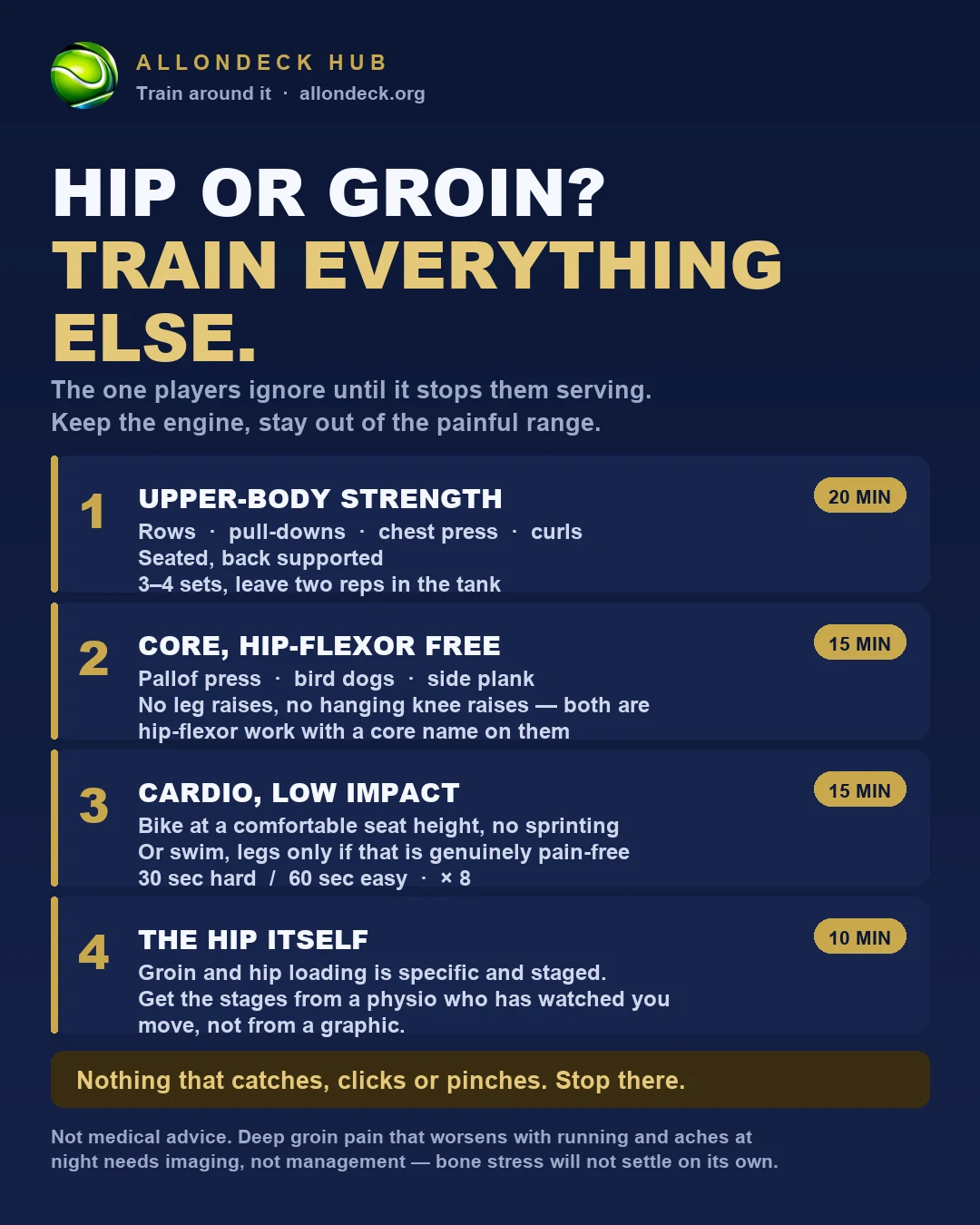
The Four Blocks
Upper-body strength
20 MINSeated, back supported.
- Rows
- Pull-downs
- Chest press
- Curls and triceps
- 3–4 sets, leaving about two reps in the tank
Core, hip-flexor free
15 MINThis is the block people get wrong. A good deal of what gets called core work is hip-flexor work with a different name on it.
- Pallof press
- Bird dogs
- Side plank, if it is comfortable
Cardio, low impact
15 MINBike at a comfortable seat height, or swim.
The hip itself
10 MINGroin and hip loading is specific and staged, and the stages matter more here than almost anywhere else.
- Get them from a physio who has watched you move
The Core Trap
If block 2 looked thin, that is the point. A player with a hip or groin problem usually responds by deciding to work on their core, and reaches for leg raises, hanging knee raises, V-sits and sit-ups with their feet hooked under something. Every one of those is loaded hip flexion. They are training the thing that hurts and calling it rehab.
Anti-rotation and anti-extension work — the Pallof press, bird dogs, planks — gets you the trunk control without the hip doing the lifting. It is less satisfying, and it is the right choice.
Why It Gets Ignored
Because it is vague. No swelling, no bruise, no moment you can point to. A nagging ache that is fine on Monday and bad on Thursday, and every player tells themselves it is tightness. Six months later it is a habit, the serve has quietly changed to avoid it, and something else has started hurting from the compensation.
If you have been calling it tightness for more than a few weeks, it is not tightness.
Read This Before You Start
This is a general conditioning session, not medical advice, and it is not a diagnosis.
This one needs imaging, not management
Deep groin pain that gets worse the more you run and aches at night needs imaging rather than a training plan. Bone stress in that area does not settle on its own and gets considerably worse if it is trained through. Get assessed too if the hip catches, clicks painfully or gives way, or if the pain radiates into the front of the thigh.
The Point of All This
Hips and groins reward early attention more than almost any other tennis injury, and punish being ignored more than most. The session above is what keeps you fit while you take it seriously — which, if you have been managing this one for months, is the actual advice.
Train around the injury with a coach who knows the sport
AllONDECK coaches build sessions around what you can do, not what you cannot. Find one near you, or work remotely.