The instinct is to lie down until it settles. For an ordinary sore back, that is usually the wrong move.
This is the one card in the set that is not about training hard. The honest answer for a sore lower back is movement — often, gently, and early. Resting it flat tends to stiffen everything and leave you weaker when you do get up.
So the session below is deliberately quiet. Walking gets the most time on it, and that is not padding.
The Whole Session in One Picture
Screenshot this. Send it to a team-mate. Take it to the court.
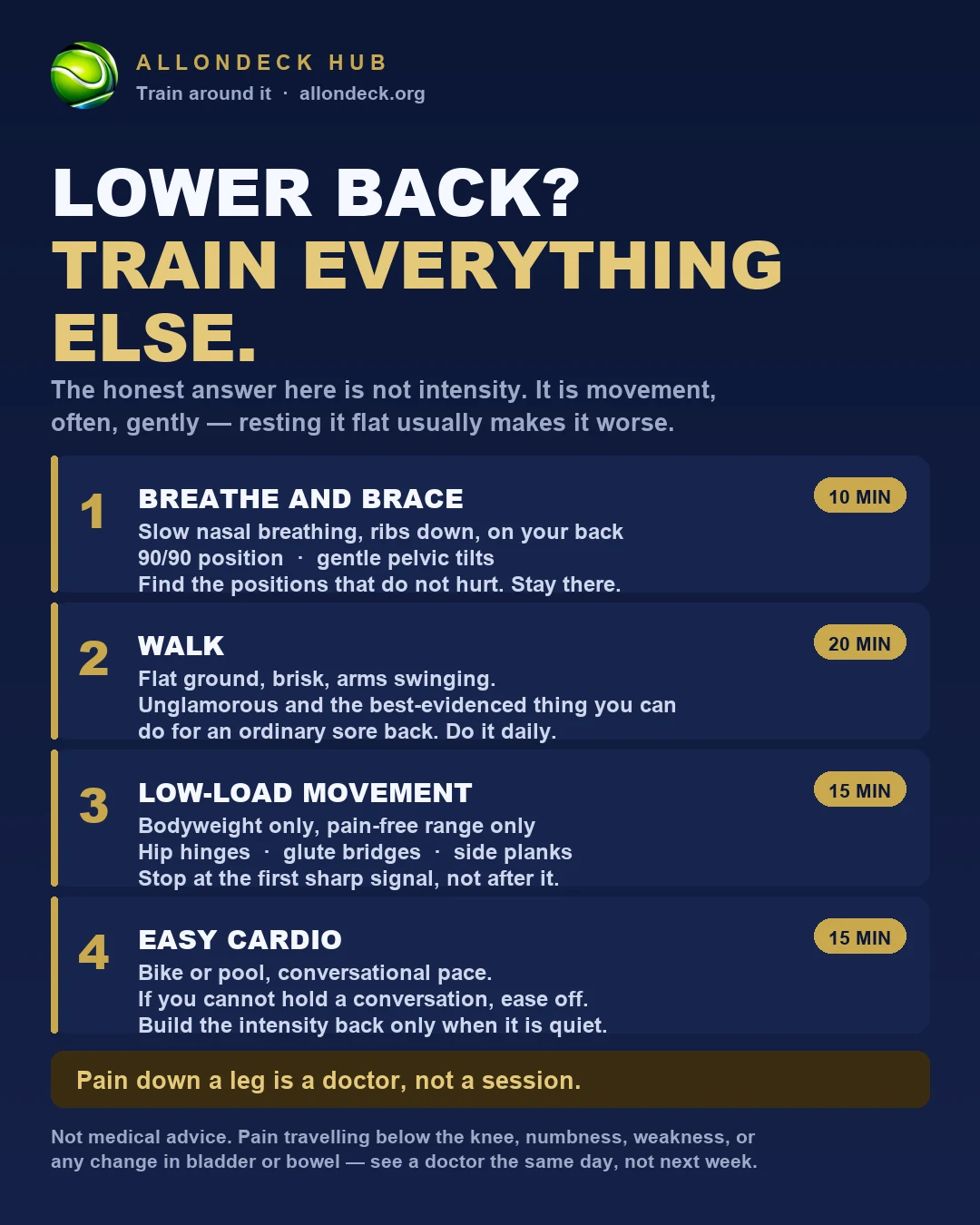
The Four Blocks
Breathe and brace
10 MIN- Slow nasal breathing, ribs down, lying on your back
- 90/90 position with your calves on a chair
- Gentle pelvic tilts
Walk
20 MINFlat ground, brisk enough to warm up, arms swinging.
- Every day, not only on session days
- Short and often beats one long walk
- Outside if you can — it is easier to keep doing
The least impressive thing on this page and the one most worth doing.
Low-load movement
15 MINBodyweight only, and only through a range that does not hurt.
- Hip hinges
- Glute bridges
- Side planks
- Cat-camel, slowly
Easy cardio
15 MINBike or pool, conversational pace throughout.
- You should be able to talk the whole way
- Build intensity back only once the back is quiet
Why Walking Gets the Most Time
Because for ordinary, non-specific low back pain — the kind with no nerve involvement and no injury to a specific structure — staying active is consistently the advice that holds up, and walking is the easiest form of it to actually do. It loads the back gently and rhythmically, it does not require a gym, and you can do it on a bad day.
Bed rest was standard advice for a long time and then stopped being, because people who rested came back stiffer and slower than people who kept moving. If you take one thing off this page, take the walking.
What About the Gym
It comes back, but later and from underneath. Loaded rotation, heavy deadlifts and anything that makes you brace and hold your breath are the last things to return, not the first. Build back through the movements in block 3 until they are genuinely boring, then add load slowly.
Tennis itself is rotation under load. Respect the order.
Read This Before You Start
This is a general conditioning session, not medical advice, and it is not a diagnosis.
These signs mean today, not next week
Pain travelling below the knee, numbness or pins and needles in the leg or foot, weakness in a leg, or any change in bladder or bowel control — see a doctor the same day. Also get checked if the pain followed a real fall or impact, or if it wakes you at night and will not settle in any position. This page is about an ordinary sore back and is not medical advice.
The Point of All This
Every other session in this set is about protecting one part and training the rest hard. A back is different, because the back is involved in everything — so the answer is not intensity somewhere else, it is keeping the whole thing moving until it settles.
Quiet and consistent beats hard and sporadic here. That is the only card in the set where that is true.
Train around the injury with a coach who knows the sport
AllONDECK coaches build sessions around what you can do, not what you cannot. Find one near you, or work remotely.